Extension and Amputation
What AI Is Doing to Us According to Marshall McLuhan

We shape our tools and thereafter our tools shape us
~ Marshall McLuhan
I have long believed that Marshall McLuhan was something of a prophet, a man who saw further into the shape of technological culture than almost anyone of his generation, and whose warnings deserve renewed attention now that artificial intelligence has moved from speculation to daily reality. This conviction sits close to home for me at present, as Josh Shepherd, Brad Brisco, and I prepare to release Movemental, a digital publishing platform built on the premise that the ethical use of AI can serve the church’s formational calling rather than erode it. McLuhan never lived to see generative intelligence, yet his insight that every extension of ourselves carries a corresponding amputation reads like it was written for this exact moment. What follows is an attempt to take his warning seriously, and to ask what a genuinely Christian and ethically grounded use of this technology might look like.
Marshall McLuhan gave us a lens for reading technology that goes deeper than asking what a new tool can do. He asked what it does to us. Every technology, he taught, is an extension of some human faculty, and every extension carries a corresponding cost. The wheel extends the foot. Clothing extends the skin. The book extends the eye. Electric media extend the nervous system itself, gathering the human family into a single anxious, instantaneous village. Whenever we externalize a function of ourselves, we gradually lose the habit of exercising it. McLuhan would probably insist that the real significance of AI is not what it doesbut what it does to us. This is McLuhan’s central insight, and it is worth sitting with as artificial intelligence becomes woven into the fabric of daily life.
The Printing Press as Parable
McLuhan’s favorite case study was Gutenberg. The press was invented to reproduce text efficiently, nothing more ambitious than that. Yet it reordered the whole shape of Western perception. It seeded the Reformation, the scientific revolution, nationalism, capitalism, and the modern university, none of which Gutenberg intended or foresaw. The medium itself did the shaping. It favored linear thought, private reading, standardization, individual authorship, and the notion of objective knowledge. A new world grew up around a machine built to press ink onto paper.
This history matters because it shows how technologies work beneath our awareness, reordering culture long before we notice the reordering has happened.
Why AI Represents a New Threshold
Earlier technologies mainly amplified the body: strength, speed, reach, the senses. AI reaches further in. It remembers, searches, organizes, translates, writes, codes, designs, and reasons within limited domains. The faculty being extended is the intellect itself, and this changes the nature of the threshold we are crossing.
McLuhan’s law of amputation presses on us here with real weight. If intellectual capacities become increasingly externalized, we are led to ask what becomes of intellectual formation. Wisdom throughout human history has grown through the slow shaping of judgment: memory exercised over years, attention sustained through difficulty, struggle absorbed patiently, contemplation given room to work. When a technology supplies conclusions without requiring these disciplines, the danger extends beyond thinking less. We risk becoming a different kind of thinker altogether, one less practiced in the very disciplines that produce wisdom.
The Environment We Are Building
McLuhan resisted simple verdicts on whether a medium is good or evil. He asked instead what environment a medium creates, since every medium rearranges the ratio of our senses and our social bonds. Environments have a way of becoming invisible to those who live inside them, the way water is invisible to a fish. We are already living inside an environment where intelligence has become ambient, instantly available, and detached from any particular mind that produced it. This is happening around us now, largely without our notice, which is exactly the condition McLuhan warned us to watch for.
The real threat carried by this environment may have little to do with machines becoming intelligent. The deeper threat is a culture that ceases to value the practices that once cultivated intelligence in human beings. Access to knowledge gets mistaken for possession of wisdom. Fluency gets mistaken for understanding. Generation gets mistaken for creation. Each of these confusions has cultural and spiritual weight, and each deserves careful attention from anyone who cares about the health of human community.
A Biblical Word on Knowing
Scripture has always understood human knowing as something formational at its root. The biblical writers show little patience for ideas held apart from a life lived. To know God is to walk with God: through discipleship, obedience, meditation, community, suffering, and love. These are not computational processes that can be run at scale. They shape the knower even as they produce knowledge, forming character alongside content. AI can generate information at extraordinary speed. Formation asks for something a machine cannot undergo, because formation depends on a body, a community, a history, and a will surrendered in obedience over time.
This gives fresh depth to McLuhan’s famous phrase. If the medium is the message, the deepest message carried by AI may not be intelligence at all. Its message may be a quiet redefinition of what it means to know, to learn, and ultimately to be human. That is a question the church has always been equipped to answer, because forming people has always been central to its calling.
The Way Forward
The communities that flourish in the years ahead, whether churches, households, or schools/universities, will likely be those that recover practices no machine can perform. Sustained attention given to Scripture and to one another. Discernment grown through community rather than retrieved as output. Contemplation that makes space for silence long enough to hear something true. Moral judgment shaped through lived obedience. Embodied presence that shows up where people are struggling. Covenantal relationships that hold across years, through failure and repair.
These practices are not nostalgic holdovers from a slower age. They may become the defining marks of a genuinely human, genuinely Christian culture in an age when intelligence itself has become technologically abundant. The invitation before the church is to take up this ancient work with fresh conviction, forming people capable of wisdom, love, and faithful presence in a world that no longer requires any of us to think, remember, or discern for ourselves. That work remains, as it has always been, ours to do together.
You have to love the irony here: AI assisted me with the graphic and with the editing of this article. We are living in a weird time!
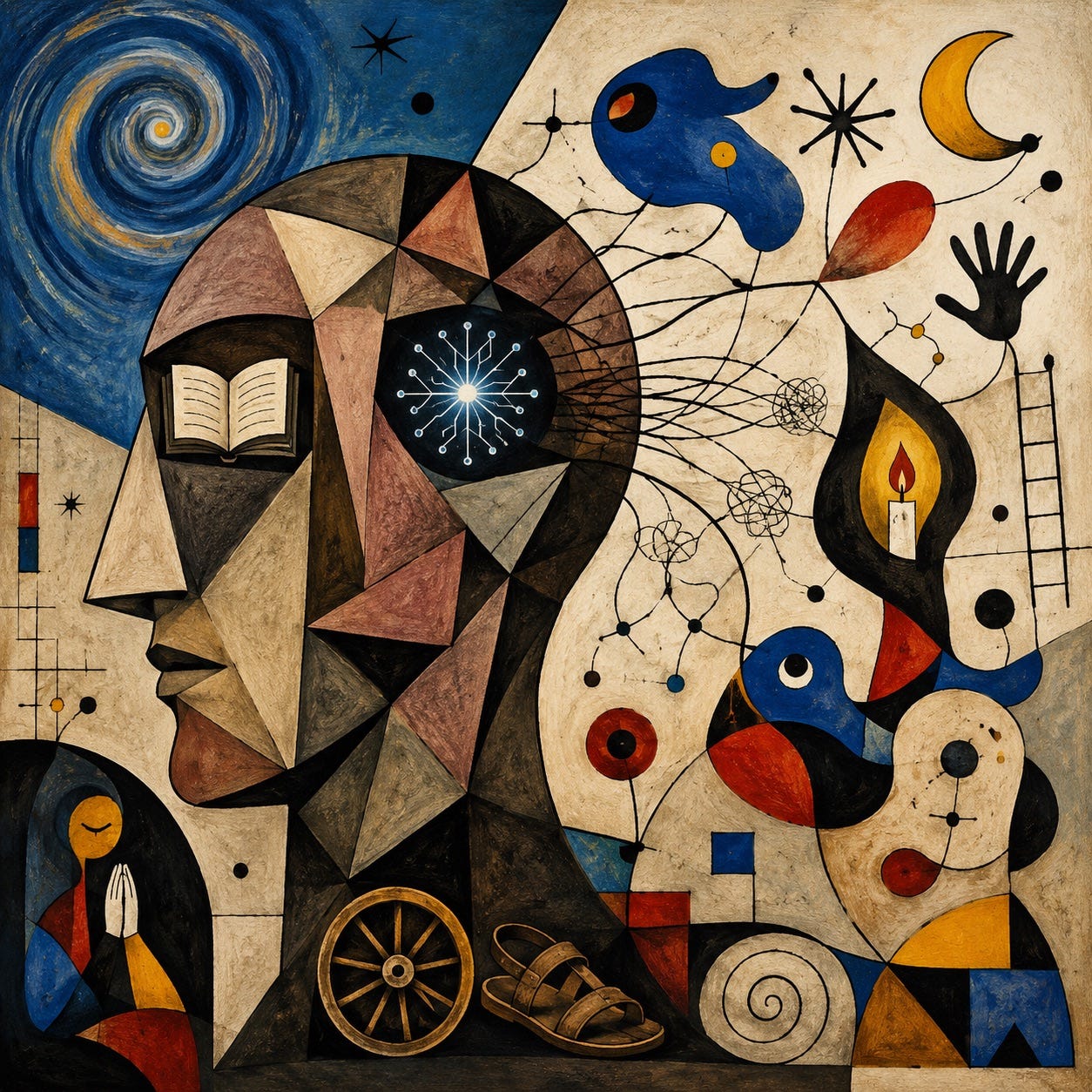
I was going through my database of aphorisms that I collected in the 80’s. These two quotes prompted this article:
In the Eighties, as we transfer our whole being to the data bank, privacy will become a ghost or echo of its former self, and what remains of community will disappear.
~ Marshall McLuhan, Living at the Speed of Light (1979), 6
This is where William Burroughs comes in with his Naked Lunch. When we invent a new technology, we become cannibals. We eat ourselves alive since these technologies are merely extensions of ourselves. The new environment shaped by electric technology is a cannibalistic one that eats people. To survive one must study the habits of cannibals.
~ Marshall McLuhan, in McLuhan, Hot or Cool. (1967), 261
I appreciated the thought around AI as an extension of our being. Rather than individual dependence on an infinite man made creation, we seek communal dependence on the infinite creator.
I wonder how we invite others to continue in the process of communal spiritual formation amidst the instantaneous aquiring of knowledge through AI.
Knowledge that forms wisdom in practice - as long as the knowledge is accurate. So many questions to ponder!